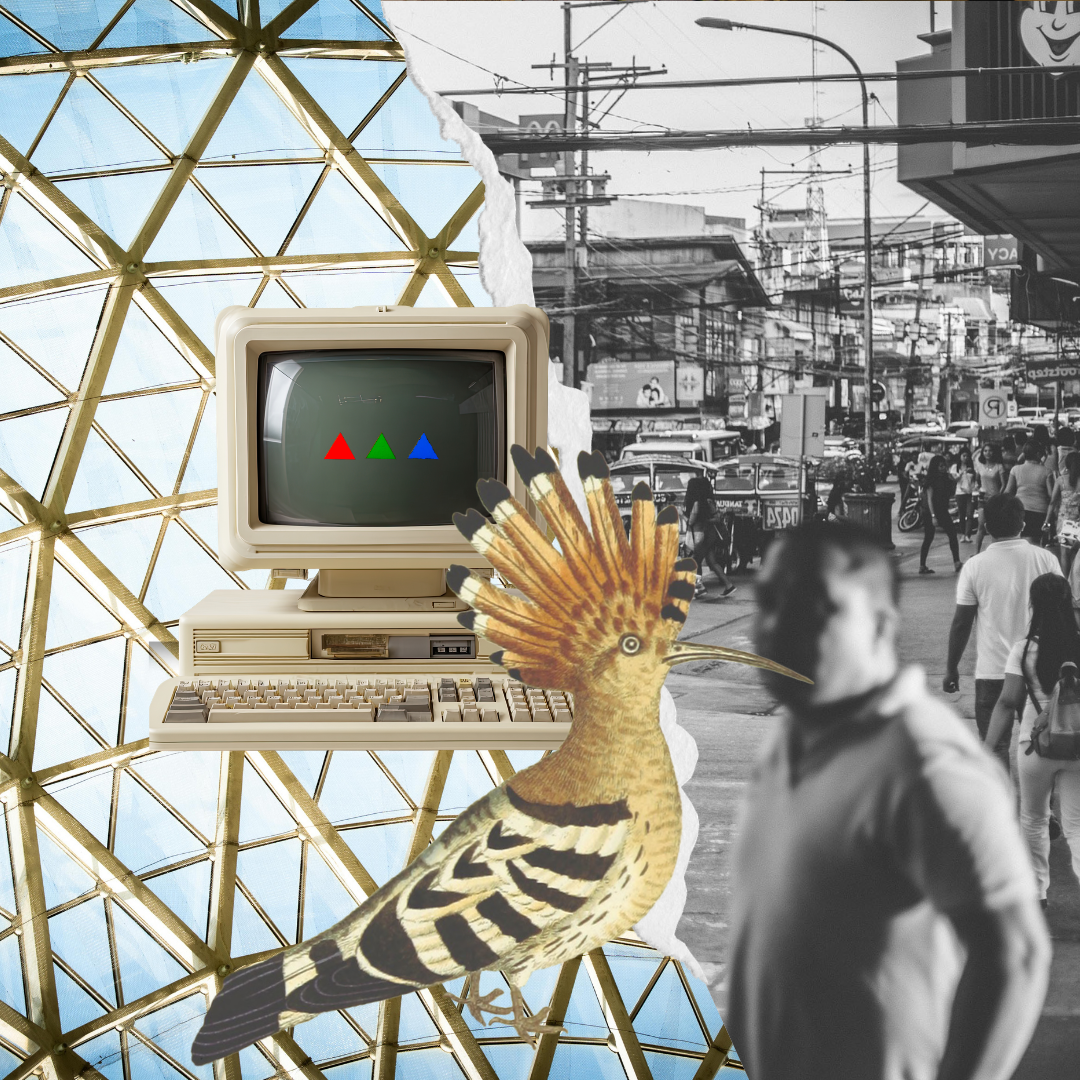
Intelligence cannot be reduced to computation alone. It manifests in ecosystems, in awakened individuals, and in the ancient wisdom we have inherited.
This conversation unfolded as an exploration of one of the defining tensions of the 21st century: humanity’s unprecedented technological advancement alongside a deepening psychological, existential, and civilisational fragmentation.
Rather than approaching artificial intelligence purely as a technological phenomenon, I proposed that the emergence of AI reveals a much larger question concerning the nature of intelligence itself — what it means to be intelligent, conscious, adaptive, and ultimately human in a world increasingly shaped by machines.
My own intellectual journey began in engineering and the study of the resilience of complex adaptive systems. During my doctoral research, I became interested not only in how systems survive shocks and crises, but in what fundamentally allows living systems — whether ecological, social, or infrastructural — to remain coherent while adapting to uncertainty. What initially appeared to be a technical question gradually became a philosophical and psychological one.
As I studied infrastructure systems, I realised that no system can truly be understood in isolation from the human beings who design, operate, inhabit, and imagine it. Failures in systems are rarely purely technical. They emerge from culture, cognition, worldview, fear, fragmentation, memory, and collective behaviour. Behind every technological system lies a deeper architecture of consciousness.
At the same time, parallel to my scientific work, I underwent a personal journey through meditation, contemplative practice, and the exploration of inner transformation. Through this process, I became increasingly aware that modern technological societies possess immense external sophistication while remaining profoundly underdeveloped in their relationship with the inner world.
This convergence between complexity science and contemplative inquiry became the foundation of my work. I began asking whether engineering itself might require a new epistemological and philosophical basis — one that includes awareness, intentionality, ethics, and consciousness as legitimate dimensions of design rather than subjective afterthoughts.
From this emerged the concept of Mindfulness Engineering, and later, Mindful Smart Cities.
In the conversation, I argued that contemporary definitions of intelligence are dangerously narrow. In technological discourse, intelligence is often reduced to optimisation, efficiency, computational capability, predictive modelling, or machine learning performance. Yet intelligence manifests itself in profoundly different ways across nature, consciousness, and human experience.
A forest demonstrates intelligence through self-organisation, adaptation, interdependence, and regenerative balance. Human beings experience intelligence through intuition, ethical insight, creativity, symbolic imagination, contemplation, and moments of profound inner awakening. Ancient civilisations cultivated forms of intelligence embedded in ritual, mythology, philosophy, spiritual practice, architecture, and ecological relationship.
Modern AI, despite its extraordinary capabilities, represents only one expression of intelligence among many.
This led me to propose the framework of Triple AI — three intelligences that must be held together if our technologies are to remain in service of life.
- I.
Artificial Intelligence
the intelligence we have built.
- II.
The Awakened Individual
the intelligence we must cultivate.
- III.
Ancient Intelligence
the intelligence we have inherited.
Three intelligences. None of them sufficient alone.
The first AI, Artificial Intelligence, represents humanity’s technological and computational capacity. It encompasses machine learning, automation, generative systems, predictive algorithms, and increasingly autonomous digital infrastructures. I emphasised that these technologies are not inherently negative; they are extraordinary extensions of human cognition and creativity. However, without ethical maturity and psychological awareness, they risk amplifying fragmentation, manipulation, hyper-consumption, surveillance, and alienation.
The second AI, the Awakened Individual, refers to the development of inner awareness and psychological maturity. In a world dominated by acceleration, distraction, and informational overload, the cultivation of attention becomes a civilisational necessity. The awakened individual is not defined through ideology or religious identity, but through an increased capacity for self-awareness, emotional regulation, ethical sensitivity, contemplative insight, and the ability to perceive interconnectedness rather than separation.
I argued that technological societies cannot become truly intelligent if the individuals inhabiting them remain psychologically fragmented, traumatised, reactive, and disconnected from themselves. The future of civilisation therefore depends not only on smarter systems, but on wiser humans capable of guiding them.
The third AI, Ancient Intelligence, refers to the immense reservoirs of knowledge preserved across human civilisations through contemplative traditions, indigenous cosmologies, mystical philosophies, symbolic systems, oral traditions, and ancient metaphysical frameworks. These traditions explored questions that modern technological societies are only beginning to rediscover: What is consciousness? What is the nature of suffering? How should humans relate to nature? What creates meaning? What constitutes a good life? How can societies remain coherent across generations?
I proposed that the future cannot be built through technological acceleration alone. Humanity requires continuity with deeper civilisational wisdom. Ancient intelligence offers psychological depth, ethical orientation, and symbolic meaning in an era increasingly dominated by abstraction and digital mediation.
The conversation then moved towards cities and urban systems. I explained that I do not approach cities merely as built environments or technical infrastructures, but as living cognitive ecologies. Cities are concentrations of memory, emotion, aspiration, trauma, culture, technology, and collective imagination. They are not passive containers; they shape consciousness itself.
Within this framework, the smart city paradigm becomes insufficient if it focuses solely on optimisation, efficiency, data extraction, surveillance, and automation. A city filled with sensors is not necessarily an intelligent city. A truly intelligent city must also cultivate psychological resilience, social trust, ethical participation, contemplation, beauty, ecological relationship, and spaces for human meaning-making.
I described this as moving from technological smartness towards conscious coherence.
A major theme throughout the discussion was fragmentation. I argued that fragmentation does not begin in infrastructure; it begins in worldview. The crises of modernity — ecological collapse, political polarisation, loneliness, anxiety, hyper-individualism, and technological alienation — all reflect a deeper rupture in humanity’s relationship with itself, with nature, and with collective meaning.
Technology often intensifies this fragmentation because it accelerates human capacities without transforming human consciousness. We become more connected digitally while remaining existentially isolated. We gain informational abundance while losing wisdom. We optimise systems while neglecting the human spirit.
This is why I proposed the need for a techno-socio-psycho- spiritual framework for the future — one that integrates technological capability, social and civic intelligence, psychological wellbeing, ethical responsibility, contemplative awareness, and civilisational wisdom.
The conversation also explored the influence of Persian mysticism and Sufi philosophy on my work, particularly the writings of Rumi and Farid ud-Din Attar.
I reflected on how Attar’s The Conference of the Birds offers an extraordinary metaphor for contemporary humanity. In the story, birds from across the world gather together searching for a king capable of bringing order and meaning. Their journey through the seven valleys becomes an allegory for transformation, uncertainty, ego dissolution, knowledge, unity, and awakening.
I interpreted the birds as symbolic representations of humanity itself — fragmented cultures, nations, ideologies, and identities attempting to navigate an age of crisis and transition. Each valley reflects a stage not only of personal consciousness, but also of collective civilisational development.
For me, this story remains profoundly relevant because humanity today stands within its own valley of quest: searching for direction amidst ecological instability, technological acceleration, existential anxiety, and the collapse of inherited narratives.
Ultimately, this conversation proposed that the future of intelligence cannot be understood solely through machines. Intelligence also exists in ecosystems, in contemplative awareness, in ethical evolution, in symbolic imagination, and in humanity’s capacity to recognise its participation within larger wholes.
The central challenge of the 21st century is therefore not simply whether humanity can build more advanced technologies.
It is whether humanity can evolve the depth of consciousness required to live wisely alongside them.
— Dr Shima Beigi
The Triple AI™ framework · February 2024